
Benefits to workplaces
Smoke-free laws and workplaces
All Australian states and territories have adopted smoke-free legislation in enclosed workplaces (with a number of exceptions and variations as laid out here).
For example, in Victoria, most enclosed workplaces became smoke-free on 1 March 2006 and licensed premises became smoke-free on 1 July 2007. From 13 April 2015, certain building entrances and the grounds of learning environments are smoke-free (for a comprehensive list see the Department of Health and Human Services Tobacco Reform website). The legislation is a minimum standard and workplace smoke-free policies can stipulate further requirements in addition to the legislation e.g. completely smoke-free grounds.

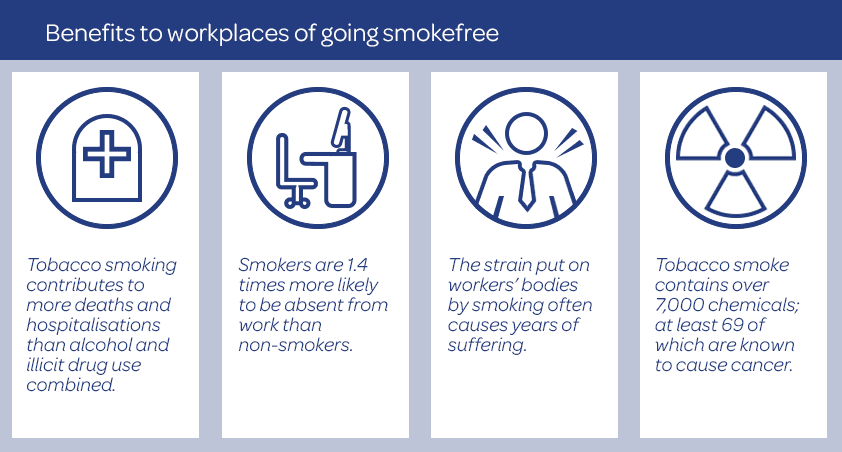
The indirect costs of smoking, such as lost productivity, often greatly exceed the direct costs to the health system*. A 2019 systematic review and meta-analysis found robust evidence that smoking increases both the risk and number of sick days in working populations, regardless of location, gender, age, and occupational class.** In Australia, people who smoke are 1.4 times more likely to be absent from work than people who don't smoke***.
In 2015-16, the workforce costs of smoking on the Victorian economy were estimated to be approximately $1.68 billion per year, including costs associated with reduction in workforce ($693.4 million), absenteeism ($355.1 million) and smoking during work breaks ($632 million)****.
Going totally smoke-free is an important step workplaces can take to reduce the harms of tobacco smoke for staff, increase productivity and reduce absenteeism.
Smoking is not just a health issue; it’s also a social and business issue.
Benefits of smoke-free workplaces
Health reasons
Smoking is a major cause of preventable death and disease in Australia. The most recent estimate of deaths and diseases caused by tobacco in Australia is for the year 2018. Tobacco use caused a total of 20,500 deaths in that year, or more than one in every eight deaths (13%). This includes deaths from active smoking and from exposure to second-hand smoke. Moreover, 8.6% of the disease burden in Australia was due to tobacco use.
Second-hand smoke is also harmful to health. It occurs when others breathe in the smoke from a person’s cigarette or from other tobacco products, such as cigars. There is no level of exposure to second-hand smoke that is free of risk. Scientific and medical evidence shows that exposure to second-hand smoke causes disease which can lead to heart disease, stroke and lung cancer.
Adhering to the law
All Australian states and territories have adopted smoke-free legislation in enclosed public places, including workplaces. To learn more about the smoking and vaping laws in your state or territory, see Smoking and vaping legislation.
Financial cost
There are several financial benefits in going smoke-free. These benefits can include reduced insurance costs, reduced risk of litigation and lower fire risk.
Community support
The vast majority of Australians do not smoke. Providing totally smoke-free environments protect staff and visitors from second-hand smoke. National surveys report that the majority of the public strongly support bans on smoking in enclosed workplaces. Similarly, surveys of community attitudes to smoking bans in outdoor areas show high support for such measures. Victorian research found 84% of adults, including the majority of people who smoke, disapprove of smoking in hospital grounds.
Environmental cost
Cigarette butts negatively impact outdoor areas. Outdoor smoking bans may help to reduce cigarette butt litter and provide cost savings through reduced clean up and refurbishment costs.
Impact on people who smoke
When smoke-free policies are introduced into workplaces, people who smoke generally reduce how many cigarettes they smoke each day. Smoke-free workplaces can also help people who smoke who are trying to quit. People who smoke trying to quit often have cravings when they are around other people who are smoking. Smoking bans remove these smoking cues for people trying to quit or for those who have already quit.
Impact on people who smoke
Having a smoke-free policy will not infringe upon the rights of people who smoke. A smoke-free policy does not ban cigarettes but simply limits their use in certain areas. For information on how to go smoke-free, take a look at our Smoke-free guide for workplaces. This resource includes a smoke-free policy which allows you to develop a policy tailored to your organisation.
(1) Rezaei S, Akbari Sari A, Arab M, Majdzadeh R, Mohammad Poorasl A. Economic burden of smoking: A systematic review of direct and indirect costs. Med J Islam Repub Iran, 2016;30:397. Available from: https://www.ncbi.nlm.nih.gov/pubmed/27579287
(2) Troelstra SA, Coenen P, Boot CR, Harting J, Kunst AE, et al. Smoking and sickness absence: A systematic review and meta-analysis. Scand J Work Environ Health, 2020;46(1):5-18. Available from: https://www.ncbi.nlm.nih.gov/pubmed/31478055
(3) Bush R and Wooden M. Smoking and absence from work: Australian evidence. Soc Sci Med, 1995;41(3):437-46. Available from: https://www.ncbi.nlm.nih.gov/pubmed/7481938
(4) Creating Preferred Futures. An analysis of the social costs of smoking in Victoria 2015–16. Hobart, Tasmania 2018.
This content is taken from Victorian sources. While it could be applied to all Australian States and Territories, to ensure accuracy we recommend consulting with localised advice.